Bid Opening turns what agencies post into what a contractor needs to decide: the requirements, the fair value of the work, and a bid built from your own costs. Buyers get bids that are complete and priced to be delivered. Bidders spend their time on the work they can win.
Appraisers value a house two ways: what comparable houses sold for, adjusted for the differences, and what it would cost to build. Bid Opening does the same for a public contract. The market approach uses closed bids on comparable jobs. The cost approach uses your own costs and margin. Then you see where your number lands.
As of October 8, 2026. Fair value and the market check are rolling out as they are built and as documents are collected, agency by agency. The worked example in this section is illustrative.
Comparable closed jobs from the agencies' own tabulations, each read against its documents, then adjusted toward the job you are pricing.
| Your job | Comp 1 | Comp 2 | Comp 3 | |
|---|---|---|---|---|
| Custodial work | 4 elementary schools | 3 schools | 5 schools | Admin and library |
| Size, sq ft | 208,000 | 172,000 | 240,000 | 96,000 |
| Bid opened | now | 2025 | 2024 | 2025 |
| Low bid, per year | ? | $318,200 | $468,000 | $199,700 |
| Per sq ft | $1.85 | $1.95 | $2.08 | |
| Size | −2% | +2% | −6% | |
| Wage floor | 0% | +5% | 0% | |
| Date | +1.5% | +3% | +1.5% | |
| Combined adjustment | −0.5% | +10.3% | −4.6% | |
| Adjusted, per sq ft | $1.84 | $2.15 | $1.98 |
A smaller job carries a higher unit price, so it is adjusted down toward yours; a county with a lower wage floor is adjusted up; an older bid is brought forward for labor costs since. The adjustments multiply, each applied to the result of the one before, and each shows its source.
Your own build in the Bid Workshop: hours from the square footage, the county's wage floor, your supplies and insurance, then your margin.
As a 20% markup instead, cost × 1.20, the bid would be $399,475. The Workshop prints both, so you always know which one you mean. Cushion and overhead have their own lines when you use them.
Build your cost first, then see where it lands. The market range never fills in your costs for you.
Worked example with illustrative numbers. Fair value is an estimate made from public bid results and the documents behind them. It is not a quote, a formal appraisal, legal or financial advice, or a promise of award. Check each comparable against its own sheet before you rely on it.
Public buying works when the right firms see the work, understand what it takes, and price it so it can be delivered. Bid Opening is built to make each of those steps shorter, for the contractor and for the agency on the other side of the sealed envelope.
The comparables come from the bid tabulations public buyers post, the sheet the clerk reads after the sealed bids are opened, matched to the specification that says what the work actually was. Here is one, read from a county's own PDF.
| Bidder | Annual bid | Off the low |
|---|---|---|
| GMSA Janitorial Division low | $10,970.08 | — |
| C & M Solutions, LLC | $14,827.00 | +35.2% |
| Spotless Glo Cleaning Services, LLC you | $15,440.00 | +40.7% |
| P2 Cleaning Services LLC | $24,766.00 | +125.8% |
| Sparkle Cleaning Inc. | $26,141.00 | +138.3% |
| Islas General Cleaning Services Inc. | $71,970.60 | +556.1% |
| Marclan, LLC · Anago of Washington, DC (Chex, Inc.) · Bybs Solutions LLC | no bid |
The app on real public data, start to finish: a county bid opening, a scored morning, the checklist, the price history, the plan holders, the expiring contracts, a debrief.
New bids scored against your own profile with the reasons written out, the closed bids still waiting on an award, recent openings near you, and the contracts about to expire. Nothing to configure beyond telling it what you do.
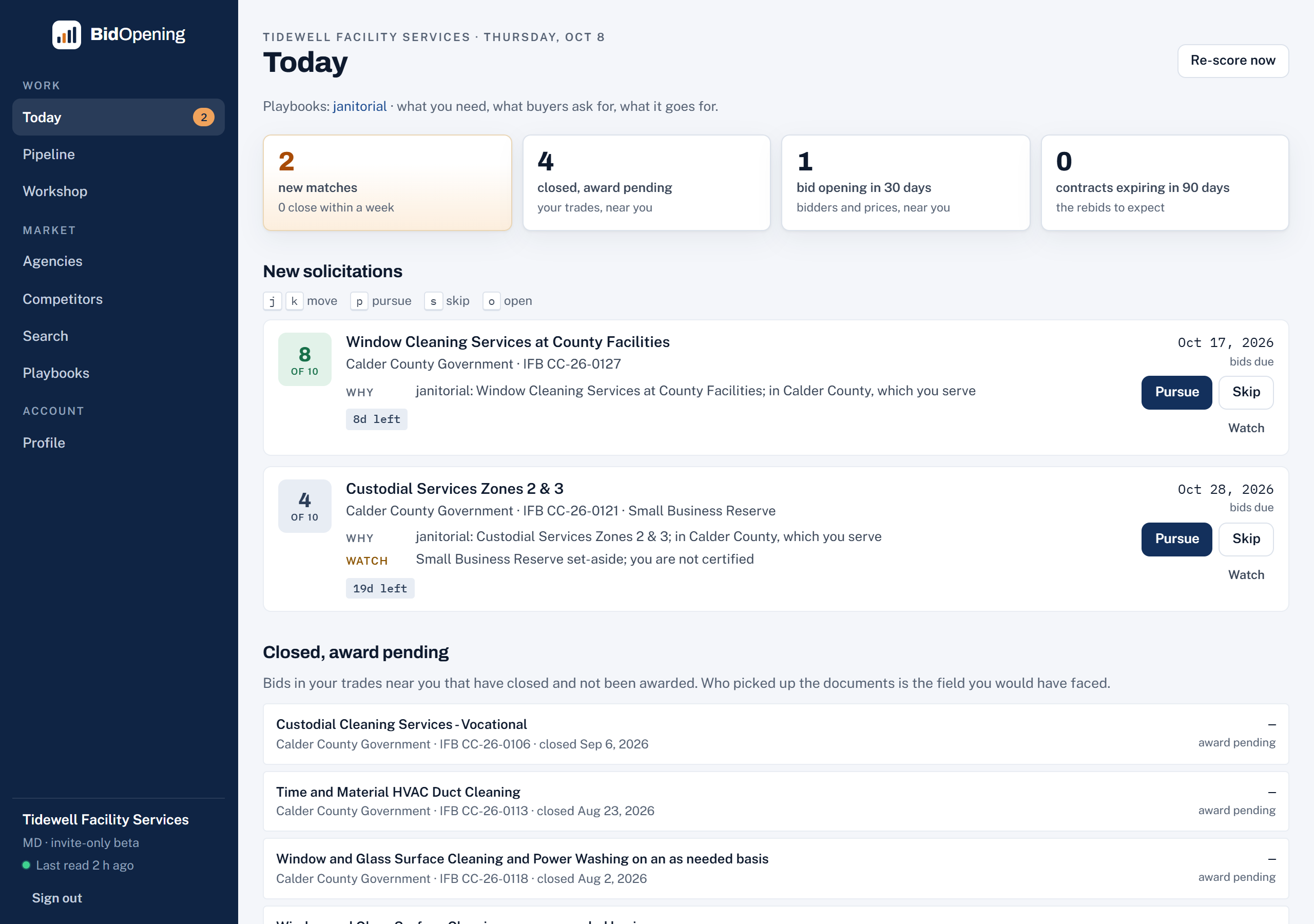
New bids in your trades are read and scored 1 to 10 against your profile. "Why it fits" and "Watch out" are written out so you can disagree with it.
Instant for anything that scores 8 or better. One digest a day for the rest: new fits, changes on bids you are pursuing, openings near you, contracts about to expire.
A checklist pulled from the documents: the mandatory pre-bid, the bond, the insurance amount, references, MBE goal, where to submit. Each item quotes the sentence it came from.
Watching, pursuing, submitted, won, lost. Enter your price when you submit; when the tab posts, the debrief shows your gap.
Bid documents, addenda and tabulations, full text. "Living wage", "floor stripping", "green cleaning": find the agencies that ask for it.
A posting is only half the story. What happens after the deadline is where the price is decided, and where your next bid gets better.
The field you will face, before the opening. Plan-holder lists, read from the agency's records, matched to the firms' bidding history.
Active contracts with their expiry, from the agencies that publish them. The rebid clock, months ahead of the posting.
The low bids we hold in your trade across the state, summarized on the bid you are looking at. Not an estimate: the actual low bids, read from the sheets.
You lost. Bid Opening tells you by how much, to whom, and what that firm has done at other agencies, so the next number is a decision instead of a guess.
One page per trade and state, for someone who has never bid public work and for someone who has bid it for years. They are written a state at a time, as each state is read; the coverage pages link the ones that are up. Each rule cites the agency page it came from and the date it was checked.
Public buyers post where they post: the county purchasing page, the school district's PDF, an authority's own site, the state board, the procurement portal. Bid Opening reads them where they are and dedupes them into one record per bid, so a change to a due date or a new addendum shows up as a change, not a new bid.
The buyers we read are listed state by state and county by county on the coverage pages.
Four steps. The tool is built around the last two, pricing and learning, because that is where a bid is won.
Bids are collected where each agency posts them and deduplicated into one record per bid.
Scored against your profile with reasons you can argue with. The checklist tells you what could disqualify you before you spend a day on it.
Comparable closed jobs adjusted the way an appraiser adjusts comparable sales, and your own cost build with your margin. Then see where your bid lands against the range.
The tabulation posts, your gap is computed, the winner's record is one click away, and the contract's expiry goes on your calendar.
Unlimited seats. The county bid above was worth $11,000 a year to the firm that won it.
The way an appraiser values a house from comparable sales. Closed bids on jobs like yours are read against their documents, adjusted for the differences that move price (size, wage floor, date, term), and reconciled into a low, likely and high figure. The code does the arithmetic, and each step shows its source. With fewer than three comparable jobs, it says there is not enough to go on.
No. It is an estimate made from public bid results. It is not a quote, a formal appraisal, legal or financial advice, or a promise of award, and the terms of service will say so. Your own costs and your own judgment decide the bid.
From the agency's own bid tabulation: the sheet the clerk posts after the sealed bids are opened. We download it, read each bidder and total on it, and link the page back to the PDF. When a sheet is a copier scan, its prices are transcribed from the image before they are used, and the page says so.
No. It finds the bid, tells you what the agency will check, what the work is worth and what it costs you to do it. The proposal and the price are yours.
Crew is $99 a month for one state; Company is $249 a month for up to five states. Month to month, unlimited seats. It is invite-only while it is new: write to hello@bidopening.com.
States are added one at a time, county by county. Tell us which one and which trades; the next state is chosen from those requests.
It tells you what the agency will check and what the work is worth. The words are yours.
Prices on screen link back to the agency document they came from. Fair value is labelled as an estimate, with its comparables beside it. If we do not have the tab, the page says so.
Invite-only while it is new. Ask for access and we will set you up.